
Technology
Jensen Huang controversy puts Southeast Asia’s AI chip trade under scrutiny
By Marcus Chen
Advertisement · Why this ad?
Marcus manages the day-to-day editorial workflow across all brands, coordinating coverage assignments and ensuring editorial standards are met. He previously served as city editor at the Pioneer Press and holds a degree in Political Science from Carleton College.
More from Marcus →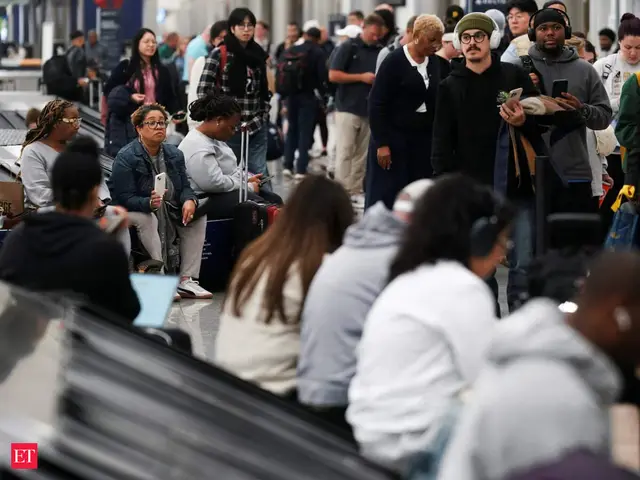
An ageing US air traffic control system, overwhelmed by new technology, triggered a nationwide ground stop on Friday, grounding departing flights across the country and diverting hundreds of aircraft, The Associated Press reported, citing US administration officials.
The Federal Aviation Administration (FAA) lifted the restriction after several hours, allowing departures to resume, but officials warned that restoring normal flight operations would take time.
'I may lose my mind': Frustrated travelers stuck in US flight havoc The disruption stemmed from communications problems at regional air traffic control centres. Transportation Secretary Sean Duffy said the country's outdated, analog infrastructure had struggled to handle the data load, while Homeland Security Secretary Markwayne Mullin said the introduction of new technology into the ageing system had overwhelmed it.
The incident also renewed questions over the state of America's aviation infrastructure, with the Trump administration calling on Congress to approve billions of dollars in additional funding to modernise the system.
Here is what happened, what caused the disruption, how it affected air travel and what comes next.
What caused the nationwide flight disruption?
The FAA grounded all flights nationwide on Friday afternoon after communications problems emerged at regional air traffic control centres. The agency cited "extraordinary circumstances" and safety concerns while issuing the ground stop.
Duffy said the US air traffic control system relied on ageing analog technology, including old switches, routers and copper communication lines, which became overloaded with data. The resulting problems disrupted communications and radar systems used by air traffic controllers.
Mullin offered a similar explanation, saying the introduction of some new technology into the existing infrastructure had overwhelmed the older system. He called for a complete overhaul, estimating that it would cost around $50 billion.
The FAA's new AI-powered SMART system, which analysed flight schedules, weather forecasts and other data to help identify potential problems, did not appear to be responsible for the disruption. Its developer, ASI, also said the ground stop was not caused by its system or its integration with the FAA.
Why did the FAA ground flights across the country?
The communications problems affected regional air traffic control centres, which manage aircraft movements between airports and coordinate with airport control towers.
With communications and radar systems facing disruptions, the FAA ordered a nationwide ground stop as a precautionary safety measure.
US flight chaos hits 1.5 million passengers, 11,000 flights: What brought skies to a halt?
Mullin said there was no indication that the communications failure was linked to a cyberattack. He also sought to dispel speculation connecting the incident to Microsoft's service disruption earlier in the week.
The incident marked the first nationwide ground stop since January 2023, when a key FAA computer system malfunctioned. Before that, the last such stoppage followed the September 11, 2001, attacks.
How long did the disruption last and when did flights resume?
The FAA lifted the nationwide ground stop on Friday evening, allowing aircraft departures to resume after several hours of disruption.
Before clearing flights to take off again, the agency said it had thoroughly tested its systems to establish that they were stable and reliable.
Duffy said around 3,500 aircraft had been in the air when the ground stoppage began. The number had fallen to fewer than 400 by the time he spoke, as aircraft were brought down safely.
However, lifting the restriction did not mean airlines could immediately return to their regular schedules. Duffy warned that restoring normal operations would be a gradual process, as aircraft and crew movements had been disrupted across the country.
How many flights and passengers were affected?
The ground stop disrupted flight operations across the US, with at least 600 flights diverted, AP reported, citing aviation analytics company Cirium.
As of 5:50 pm Eastern time, 496 flights had been diverted back to their original departure airports, while another 104 had been sent to different airports, according to Cirium.
Around 11,000 flights carrying more than 1.5 million passengers were scheduled to depart from US airports after 4 pm Eastern time, raising the prospect of further cancellations and diversions, the report said.
The disruption also spilled over into international travel. Mexico's federal aviation agency said all scheduled flights departing from Mexican airports for the US had been grounded. Air Canada said it had cancelled flights to and from the US for the remainder of Friday evening, while Europe's aviation agency suspended US-bound departures at the FAA's request.
JetBlue said it had cancelled all remaining domestic flights on Friday evening, with only Europe-bound flights from Boston Logan International Airport and New York's John F Kennedy International Airport allowed to depart. The airline warned that disruptions, including additional cancellations, could continue into Saturday.
Air cargo operations were also affected. FedEx said it was monitoring the situation and was prepared to activate contingency plans to minimise service disruptions, adding that normal flight operations would resume as soon as the FAA permitted.
What was the impact on passengers and airlines?
Passengers faced long waits at airports, diverted flights, missed connections and uncertainty over when they would reach their destinations.
Some travellers remained stuck aboard aircraft for hours after landing because gates were unavailable. Others waited at terminals without receiving clear updates, even after the FAA lifted the ground stop.
Airlines also struggled to reposition aircraft and crews following the disruption. Passengers were advised to check directly with their airlines for updates on flight status and rebooking arrangements.
The disruption did not automatically entitle passengers to additional compensation from airlines, as per AP. Since an FAA computer or communications problem was considered outside an airline's control, carriers were required to offer free rebooking to passengers who wanted to continue their journeys or refunds to those whose flights were cancelled and who chose not to travel.
The disruption also affected the sporting calendar. NBA, NHL and college football teams were among those stranded or unable to reach their destinations in time for weekend fixtures.
Several college football teams arranged alternative transport, including chartered buses, while some games had their start times changed to accommodate travel delays.
What is the US government doing to fix the problem?
The disruption renewed pressure on the US government to modernise the country's ageing air traffic control infrastructure.
Congress approved $12.5 billion for the modernisation project last year and ever since, miles of old copper wires have been replaced with fibre-optic lines, while older radio systems have gradually been replaced at airports across the country, AP reported.
However, the administration said additional funding was needed to complete the overhaul. The White House was lobbying Congress to approve another $30 billion for the project.
Duffy highlighted the poor condition of several air traffic control facilities, saying many towers were almost 100 years old and had problems such as leaking roofs, malfunctioning air conditioning and broken elevators. He also pointed to the system's reliance on outdated switches, routers and copper communication lines, AP reported.
Mullin estimated that a complete overhaul of the air traffic control system would cost around $50 billion, the report said.
Could the disruption happen again?
Duffy did not rule out the possibil
New York
Technology
Saturday, November 14, 2026
5 min
By Marcus Chen
By Marcus Chen

By Marcus Chen

By Marcus Chen